
Menu
Artificial intelligence is quickly becoming one of the most important business technologies of our time. Organizations are using AI to automate repetitive work, improve customer service, analyze information, strengthen cybersecurity and help employees make faster, better-informed decisions.
However, simply purchasing an AI subscription does not create meaningful business value.
Successful AI adoption requires a clear strategy, reliable data, secure technology, employee training and a detailed understanding of how your organization operates. That raises an important question:
Does your managed IT services company truly understand how AI can contribute to your organization’s success?
Or are they simply recommending the latest tools without understanding your business?
A capable managed IT services provider should never begin an AI conversation by immediately recommending a particular platform.
The first questions should be about your organization:
AI should be selected and configured around these answers.
For one organization, the greatest opportunity may be automating document processing. Another may benefit from an internal AI assistant that helps employees locate policies, procedures and technical information. A professional services company might use AI to summarize meetings and prepare reports, while a manufacturer could use it to analyze maintenance records or production data.
Your IT provider must understand the difference between adopting AI because it is popular and adopting AI because it solves a measurable business problem.
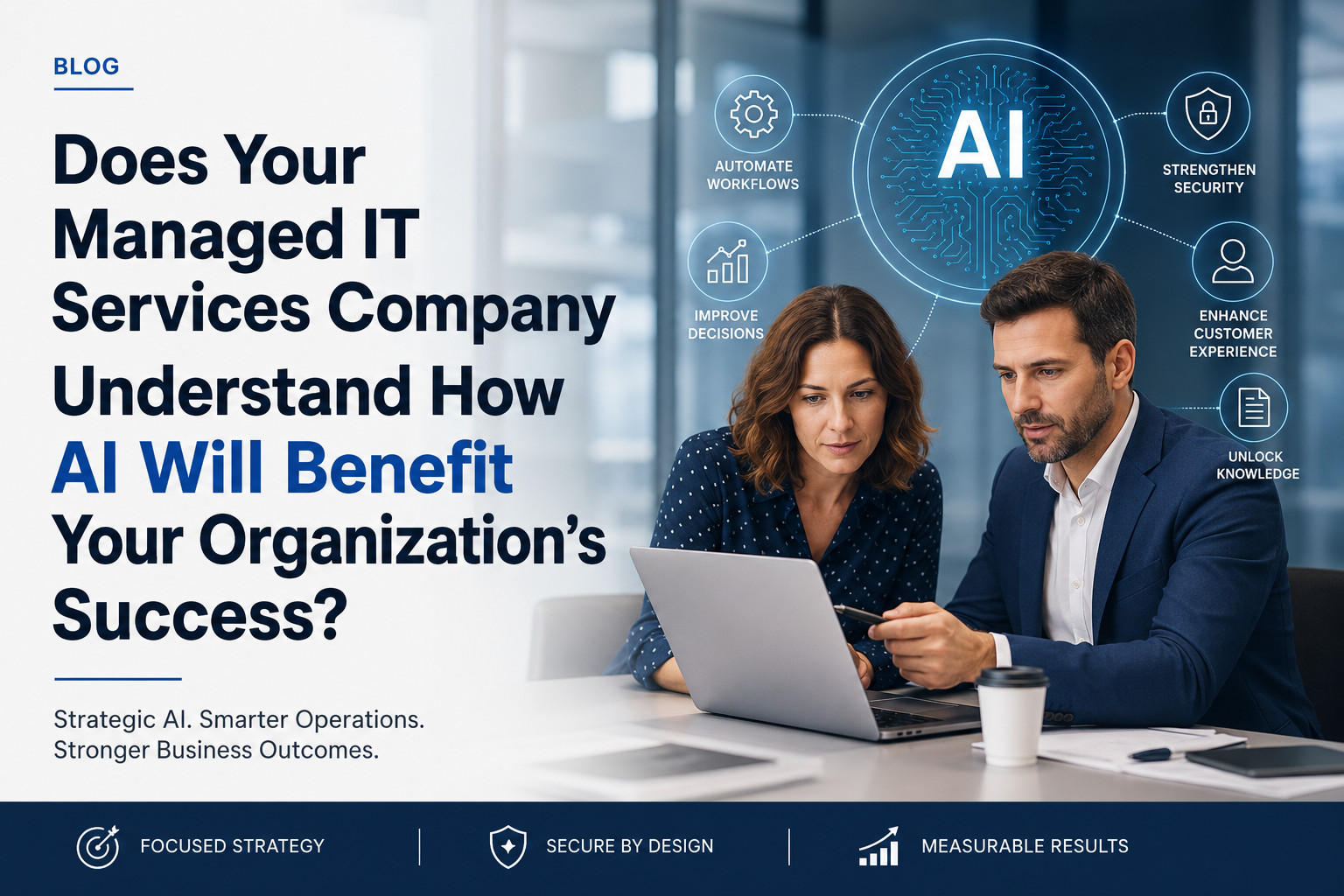
Although interest in AI is growing rapidly, many organizations are still determining how to use it effectively.
Some businesses have introduced generative AI tools without developing policies, training employees or identifying the business outcomes they hope to achieve. Others remain uncertain about data privacy, security, accuracy and the potential effect on their workforce.
This creates both an opportunity and a risk.
Organizations that adopt AI strategically may gain an important advantage in productivity, customer responsiveness and operational efficiency. Those that rush ahead without proper planning may create security problems, expose confidential information or invest in applications that employees rarely use.
A knowledgeable managed IT services company should help your organization move forward without exposing the business to unnecessary risk.
AI strategy should not consist of vague promises about digital transformation. Your provider should be able to identify specific opportunities connected to the way your employees already work.
AI can assist with routine activities such as summarizing documents, organizing information, preparing first drafts, processing forms and extracting information from invoices or reports.
The objective should not necessarily be to eliminate positions. In many organizations, the greater opportunity is helping employees spend less time on low-value administrative work and more time serving customers, solving problems and growing the business.
Employees often lose valuable time searching through email, shared folders, policies, project files and old documents.
A properly designed AI knowledge assistant can help authorized employees find and summarize organizational information using natural-language questions. However, permissions must be configured carefully so employees can access only the information they are authorized to see.
AI can help customer-service teams summarize previous conversations, prepare responses, categorize inquiries and identify urgent issues.
It can also provide customers with faster access to routine information while allowing employees to concentrate on situations requiring judgment, empathy and personal attention.
AI can analyze large volumes of operational information and help identify trends, exceptions and potential areas of concern.
Managers may use these capabilities to review sales activity, service performance, inventory, customer feedback, project information or financial data.
The final decisions should still involve qualified people. AI should support human judgment rather than quietly replace it.
AI is increasingly incorporated into security platforms to help analyze alerts, detect unusual activity and prioritize potential threats.
At the same time, cybercriminals can use AI to create more convincing phishing messages, automate attacks and increase the volume of malicious activity.
Your managed IT provider should understand both sides of this equation: how AI can strengthen security and how it is changing the threat environment.
The effectiveness of an AI solution depends heavily on the quality, organization and accessibility of the information supporting it.
Before deploying AI, your managed IT services company should evaluate:
An AI assistant connected to poorly organized or outdated information may produce inaccurate or inconsistent results.
An AI application connected to overly broad permissions may expose confidential material to employees who should not see it.
AI readiness therefore begins with good information management.
Employees may already be experimenting with publicly available AI applications.
Without clear policies, they could unknowingly enter customer information, internal reports, financial data, intellectual property or other confidential material into services that have not been approved by the organization.
Your managed IT provider should help establish clear answers to questions such as:
Your IT company does not need to turn every AI project into an overly complicated compliance exercise.
It should, however, demonstrate that security, privacy, accountability and risk management are built into the project from the beginning.
Even the best technology will fail if employees do not understand it, trust it or know when to use it.
A responsible AI implementation should include:
Employees should understand that AI can produce information that sounds confident but is incomplete, outdated or incorrect.
Human review remains essential, particularly for financial, legal, medical, employment, safety or customer-impacting decisions.
Your managed IT services company should therefore be prepared to work with management and employees—not just install software.
Your provider should be able to explain how the success of an AI initiative will be evaluated.
Useful measurements might include:
Beginning with a focused pilot project is often more effective than attempting to introduce AI across the entire organization at once.
A pilot allows the business to test the technology, collect employee feedback, measure results and identify potential risks before making a larger investment.
You should be cautious when a managed IT services company:
A provider that understands AI should be willing to discuss where the technology may not be appropriate—not only where it can be sold.
During your next technology-planning meeting, ask your provider:
The quality of the answers will tell you whether your provider sees AI as a strategic business capability or simply another product to resell.
AI will not improve an organization merely because it has been installed.
Real value comes from understanding the business problem, selecting the right technology, preparing the data, protecting sensitive information, training employees and measuring the results.
A modern managed IT services company should help your organization:
The opportunity is significant—but only when organizations approach AI adoption with clear goals, realistic expectations and responsible guidance.
The question is no longer whether AI will affect your business.
The real question is whether your managed IT services company has the business knowledge, technical expertise and strategic vision to help you benefit from it.
Is your current IT provider preparing your organization for an AI-powered future—or waiting for your competitors to get there first?